Learning the facts about Borobudur history provides a better understanding of why this ancient monument remains important today. Borobudur has experienced centuries of development, periods of decline, rediscovery, restoration, and preservation. Its long history reflects the cultural and religious changes that have shaped Central Java over time.
Borobudur Was Built in Ancient Java
Borobudur was constructed in Central Java during the ancient Javanese period. Its development is generally connected with the Sailendra Dynasty, which supported Buddhist traditions in the region.
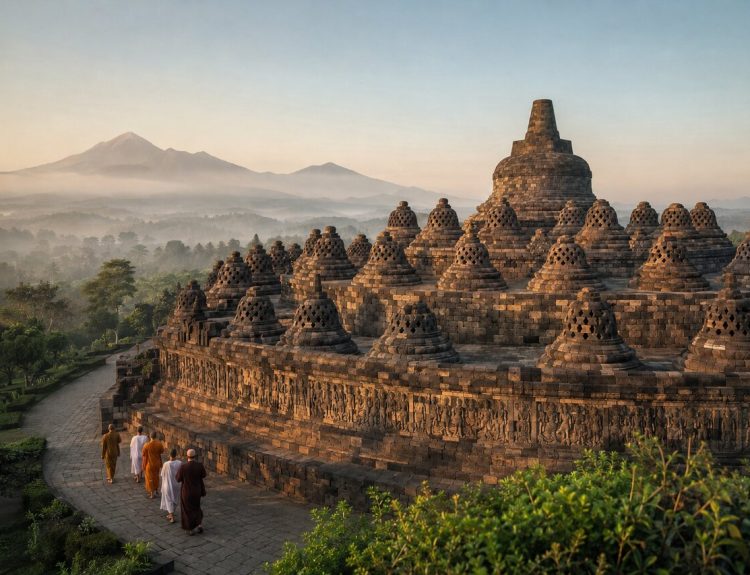
The construction of such a large monument required careful planning and skilled craftsmanship. Builders arranged large quantities of volcanic stone to create terraces, galleries, stairways, statues, and stupas.
The scale and complexity of the project demonstrate the advanced building knowledge available in Java many centuries ago.
The Monument Has a Buddhist Foundation
Borobudur was created as a Buddhist monument and incorporates religious ideas into its architectural design. Its structure encourages visitors to move gradually from the lower levels toward the summit.
The galleries contain reliefs and Buddha statues, while the upper circular platforms feature numerous stupas.
This arrangement connects the physical experience of walking and climbing with the monument’s broader spiritual purpose.
Borobudur Contains Detailed Historical Reliefs
The reliefs provide an important part of Borobudur’s historical character. Thousands of carved panels cover sections of the monument, showing religious narratives as well as scenes involving people, animals, buildings, and natural surroundings.
These carvings give visitors a visual impression of the world represented by ancient artists.
The reliefs also demonstrate how storytelling became integrated into the architecture rather than appearing as a separate form of decoration.
For travelers who want to explore more information about Borobudur’s history, architecture, Buddhist meaning, and interesting details, this Borobudur facts guide provides a broader overview.
Borobudur Eventually Became Neglected
At some point in its history, Borobudur stopped functioning as an active Buddhist center. The reasons behind its decline are associated with broader historical changes in Java, including shifts in political and religious centers.
Over the centuries, vegetation grew around parts of the monument. Natural conditions also affected the stone structure.
As a result, Borobudur became less visible and less known to the wider world.
Rediscovery Changed Its Modern History
Borobudur attracted renewed attention during the nineteenth century. Documentation and exploration helped reveal the scale and significance of the monument.
Further preservation work gradually improved understanding of its structure and condition.
This period marked an important transition from a largely neglected monument to a protected cultural heritage site.
Restoration Preserved Its Architectural Heritage
Large restoration projects have played an important role in protecting Borobudur. Conservation specialists worked to address structural problems and reduce damage caused by environmental conditions.
These efforts helped preserve the terraces, reliefs, stupas, and other architectural elements for future generations.
Modern conservation continues to be important because an ancient stone monument requires regular attention and careful management.
Borobudur Remains Important Today
The facts about Borobudur history show how the monument has survived through many different periods. From its construction in ancient Java to its decline, rediscovery, restoration, and modern preservation, Borobudur has experienced a long and complex journey.
Travelers who want to visit Borobudur and other destinations around Central Java can also explore Borobudur Tours.
Understanding this history can change the way visitors experience the monument. Its terraces and stupas are not simply architectural features. They represent a cultural legacy that has continued to attract visitors and preserve connections with the history of ancient Java.